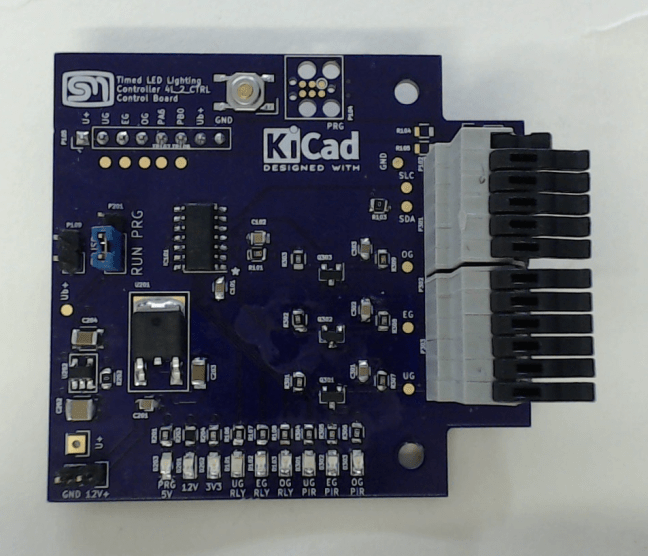
In this post I describe the trials an tribulations of bringing up my Timed LED Lighting Controller and how I went about implementing my first I²C Slave Driver for the ATTiny20. I was keen to receive the boards for the Timed LED Lighting controller to know if they would fit in the chosen housing. The … Continue reading Back to Blinky
“Mocking” – Minimising Risk
In the last post for the Timed LED Lighting Controller, I had figured out the circuit and a basic layout and approach that I was happy with. That is to separate the hazardous voltage from the control circuitry by putting it on a separate board. But still, this was not enough. I need to assemble … Continue reading “Mocking” – Minimising Risk
Timed LED Lighting Control – Design
From Logical to Physical Before I could start to translate the block diagram into KiCad, I needed to be sure about some of the parts I will be using. I want to reuse what I already have installed, so the motion detection module is already a given, along with the LED drivers. The micro controller needs three … Continue reading Timed LED Lighting Control – Design
Stairwell Foot Lighting System
When getting back into electronics, one of the projects I had in mind was to revamp our stairwell lighting system. In 2010, we renovated our stairwell. I took the opportunity to design in a foot-lighting system that was motion controlled. It has worked faultlessly for the last six years. But who can stop at revision … Continue reading Stairwell Foot Lighting System
Wrapping up the Alarm Clock Project
It has been a long while since the last post. Amongst other things, the clock has been a work-in-progress. Each time I made some progress, I found some new reason to create a revision. The initial revisions where based on issues and oversights. I am finding that as the project matures, the nature of the … Continue reading Wrapping up the Alarm Clock Project
Revisiting an old project
Some Background I recently had the opportunity to revisit an old project of a doorbell extension that used the ELV FS20-S4SUB to send a signal to the ELV FS20 SIG-2. At the time I did this with what I knew at the time to get the job done with the equipment I had. This meant nothing … Continue reading Revisiting an old project
One Year of Contextual Electronics
Before Contextual Electronics, I knew I wanted to get back into practical electronics, after a very long break. But I still had a lot to learn or re-learn. My study days left my head spinning trying to grasp operational amplifiers with two or three pages of algebra and still did not know exactly how they … Continue reading One Year of Contextual Electronics
The Main Board
I created the main board in the same pattern as the original. That made for quite an expensive prototype as there is a lot of empty space. This size is needed to fit the tactile switches in their proper places. Now that I have Revision 2 up and running, a write up of what I have … Continue reading The Main Board
Further testing the μController Display Module
In the last post, I was able to get the μController version of the display module working with a basic test routine that proved that 1. the controller could be programmed and 2. the display was being driven correctly. The next stage is to flesh this out to replicate the MAX2771 API. The purpose here … Continue reading Further testing the μController Display Module
Powering up the μController Display Module
In the last post, I set up the infrastructure on my newly configured PC to make sure that it can at least communicate and program a chip. I needed to do this before jumping in and starting to program the μControll based display module to minimise the number of issues to be encountered. Initial Check … Continue reading Powering up the μController Display Module